ABSTRACT
OBJECTIVE: Point-of-care ultrasound (POCUS) has been employed to assist with invasive techniques, such as suprapubic aspiration (SPA). We aimed to conduct a meta-analysis to compare the effectiveness of suprapubic bladder aspiration in children, with and without the use of POCUS.
METHODS: We conducted a systematic search across the MEDLINE, EMBASE and Cochrane Central Register of Controlled Trials databases for articles published through February 2025. Eligible studies included randomized controlled trials (RCT) comparing SPA with and without POCUS in pediatric populations. Data extraction focused on overall procedural success rates, as well as rates of success at first and second attempts.
RESULTS: We analyzed seven trials collectively evaluating 468 suprapubic bladder aspirations. POCUS-guided SPA showed higher overall success rates (OR = 4.88; 95% CI: 2.36–10.09; p < 0.0001; I2 = 10%). Although no significant difference was found in first-attempt success, POCUS improved success within two attempts (OR = 7.75; 95% CI: 1.54–39.09; p = 0.01; I2 = 61%), although without significantly reducing the mean number of attempts. However, sensitivity analysis showed a benefit after the exclusion of one outlier study.
CONCLUSIONS: POCUS improves SPA success in children and may enhance sterile urine collection, although training and equipment access remain challenges.
Keywords:
Point-of-care systems; Ultrasonography; Urine specimen collection; Infant; Infant, newborn.
RESUMO
OBJETIVO: A ultrassonografia à beira-leito (POCUS) é uma ferramenta utilizada para auxiliar em técnicas invasivas, como a aspiração suprapúbica (ASP). O objetivo deste estudo foi realizar uma meta-análise para comparar a efetividade da aspiração vesical suprapúbica em crianças com e sem o uso de POCUS.
MÉTODOS: Foi realizada uma busca sistemática nas bases de dados MEDLINE, EMBASE e Cochrane (CENTRAL) até fevereiro de 2025. Foram incluídos ensaios clínicos randomizados que compararam a ASP com e sem o uso de POCUS em populações pediátricas. A extração de dados concentrou-se nas taxas de sucesso do procedimento em geral e nas primeiras e segundas tentativas.
RESULTADOS: Sete estudos (n = 468) foram incluídos na análise. A ASP guiada por POCUS apresentou maiores taxas de sucesso geral (OR = 4,88; IC 95%: 2,36–10,09; p < 0,0001; I2 = 10%). Não houve diferença significativa no sucesso à primeira tentativa, porém o sucesso em até duas tentativas foi maior (OR = 7,75; IC 95%: 1,54–39,09; p = 0,01; I2 = 61%). O POCUS não reduziu significativamente o número médio de tentativas, embora a análise de sensibilidade tenha demonstrado benefício após a exclusão de um estudo discrepante.
CONCLUSÕES: O uso do POCUS aumenta as taxas de sucesso da ASP em crianças e pode favorecer a obtenção de amostras urinárias estéreis, embora o treinamento e o acesso ao equipamento ainda representem desafios.
Palavras-chave:
Sistemas automatizados de assistência junto ao leito; Ultrassonografia; Coleta de urina; Lactente; Recém-nascido.
INTRODUCTION
Urinary tract infections are one of the most common bacterial infections in children and the leading cause of bacterial infections in infants(1–3). Ten percent of children experience at least one infection between 1 month and 6 years of age(4). Although early diagnosis is important given the risk of long-term renal injury, obtaining a sterile urine specimen can be challenging, especially in children who are not toilet trained(5). Urine collection, which can be performed by using noninvasive methods, such as a bag or clean-catch technique, or invasive methods, such as bladder catheterization or suprapubic aspiration (SPA), is essential for confirming the diagnosis(6). However, each of those techniques has its limitations, particularly regarding contamination rates, which can lead to false positives(7). Clinical guidelines generally recommend clean-catch sampling or SPA as preferred methods(8), with SPA presenting the lowest contamination rates in urine sample collection, as well as exhibiting high sensitivity(9,10).
Point-of-care ultrasound (POCUS) has become an important procedural tool in clinical practice, providing a noninvasive approach to assess bladder size and anatomical positioning prior to invasive techniques, such as SPA(11). The use of POCUS facilitates visualization of the urinary bladder, aiding in localization and ensuring adequate urine sample collection(12). The use of ultrasound can also increase urine collection by precisely locating a full bladder, providing real-time visualization during the procedure, which may reduce complications and improve the SPA success rate(13). However, despite the increasing use of POCUS in multiple clinical contexts, there is a lack of consensus among studies evaluating the effectiveness of this tool for SPA, particularly for improving procedural success.
Although some single-center studies suggest that the use of POCUS improves SPA success, robust evidence of its superiority over the blind technique remains limited. Therefore, the aim of this systematic review and meta-analysis was to address this gap by comparing SPA performed with and without POCUS, in children. Specifically, we evaluated differences in success rates (overall and at first or second attempt), as well as the mean number of attempts required in order to obtain a successful sample, providing a critical analysis that may directly impact clinical practices for urine collection in children. By critically analyzing these outcomes, we hope to generate evidence to improve clinical practice for urine collection in pediatric patients.
MATERIALS AND METHODS
This was a systematic review and meta-analysis, performed in accordance with the Cochrane Collaboration and the Preferred Reporting Items for Systematic Reviews and Meta-Analyses guidelines(14). The protocol for this review was registered in the International Prospective Register of Systematic Reviews (Identifier: CRD420250652095)
Search strategy and inclusion criteria
A systematic digital search was conducted across the MEDLINE, EMBASE and Cochrane Central Register of Controlled Trials databases by two authors (S.M. and B.S.R.), working independently, up to February 2025. The search strategy included the terms “Ultrasonography”, “Ultrasound”, “Point of care ultrasonography”, “POCUS”, “Suprapubic aspiration”, “Bladder aspiration”, “Bladder puncture”, “Suprapubic puncture”, “Infant”, “Infants”, “Newborn”, “Neonate”, “Pediatrics”, “Pediatric”, “Child”, and “Children”. The complete search strategy can be found in Appendix 1. The same two researchers (B.S.R. and S.M.), working independently, screened titles and abstracts for eligibility, consulting a senior investigator in case of disagreements. Full texts, supplementary materials, online appendices, and reference lists of eligible studies were reviewed to ensure compliance with the inclusion criteria and identify additional relevant studies. Discrepancies were resolved through discussion with other reviewers until consensus was reached.
To be included, articles had to meet all of the following criteria: including data from prospective randomized controlled trials (RCTs); having enrolled pediatric patients (< 24 months of age) who underwent SPA; having compared the SPA procedure with and without the use of POCUS; having been published as a full-text article. Observational studies that did not compare POCUS-guided SPA with traditional SPA were excluded.
Data analysis and quality assessment
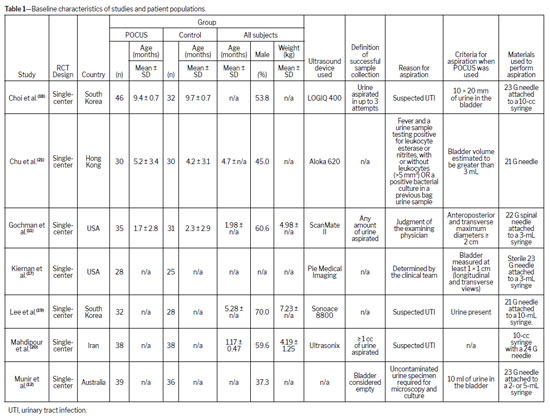
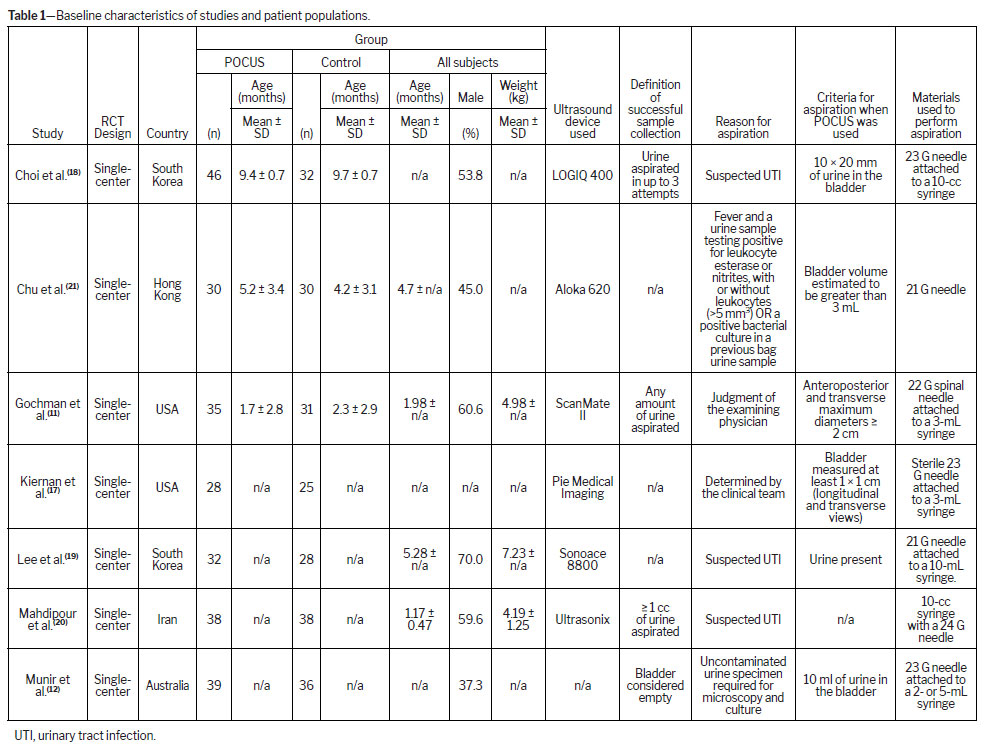
A comprehensive data extraction process was conducted by two investigators (E.F.M. and L.B.S.C.), working independently, including population data such as the number of patients, mean age, gender distribution, mean weight, and indication for SPA. Specific information regarding SPA was also collected, covering aspiration criteria when POCUS was used, materials for the procedure, the definition of a successful sample, and the ultrasound device employed. Each of the studies included defined “successful sample” differently, as detailed in Table 1. Definitions included aspiration of urine within up to three attempts, obtaining any amount of urine, requiring a minimum volume of 1 cc, or considering the bladder empty after aspiration. In three studies, the criteria for success were not explicitly stated. These variations were recorded during data extraction and were considered in the qualitative synthesis and sensitivity analyses. The main outcome collected was success rate, with success at first attempt, success up to second attempt and mean number of attempts as secondary outcomes. The risk of bias was assessed by using the Cochrane risk of bias tool for randomized trials, designated the RoB 2 tool(14). Potential bias was evaluated across five domains—randomization process, deviations from intended interventions, missing outcome data, measurement of the outcome, and selection of the reported result— each study thus being classified as having a high, low, or unclear risk of bias.
Odds ratios with 95% confidence intervals were combined using a random-effects model to evaluate treatment effects for categorical outcomes. Heterogeneity was assessed through the use of the Cochran Q test and calculation of the I
2 statistic, with significance defined as
p < 0.10 and I
2 > 25%, respectively. Statistical analyses were performed using the software Review Manager, version 5.4
(15) and R-Studio, version R-4.3.3
(16,17). A leave-one-out sensitivity analysis was conducted to determine the impact of individual studies on the overall meta-analysis results.
RESULTSStudy selection and baseline characteristics
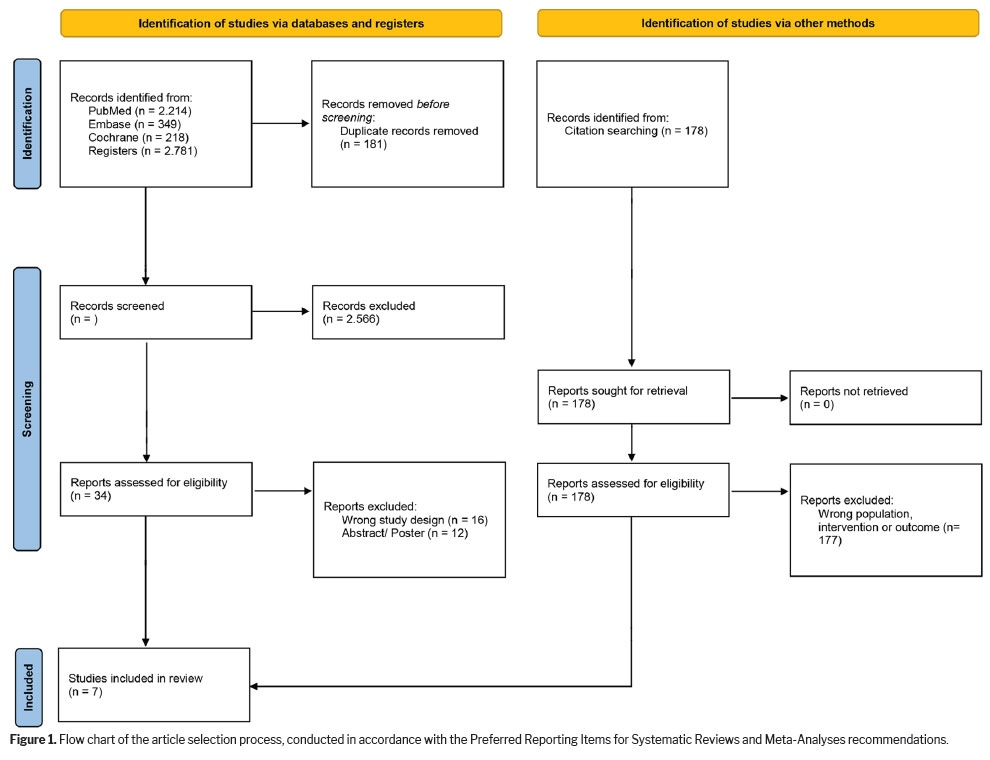
The systematic search identified 2,781 studies; after duplicates had been removed, 2,600 remained. Through title and abstract screening, an additional 2,566 studies were removed. The remaining 34 studies underwent full-text evaluation, which resulted in the exclusion of 27 studies. Therefore, seven RCTs were included in the final analysis
(11,12,18–22). The screening and eligibility process is illustrated in Figure 1.
The studies included a collective total of 468 participants, with 248 allocated to the POCUS groups and 220 allocated to the control groups. The population consisted of neonates and infants, with mean ages ranging from 0.47 to 9.7 months and mean weights ranging from 1.25 to 7.23 kg. Among the seven studies included, age was reported in four and weight was reported in three.
Success rates
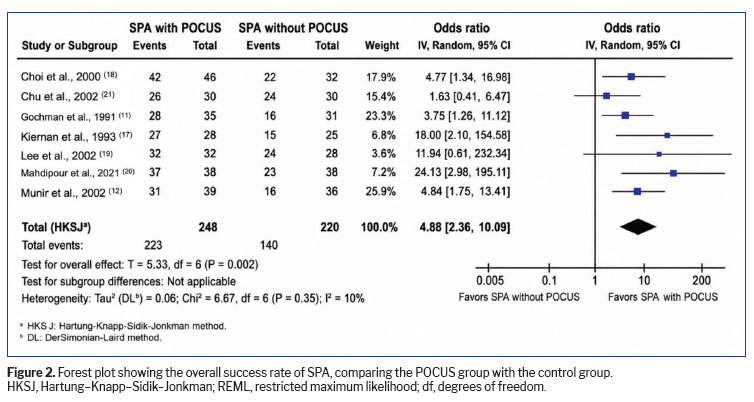
The pooled analysis demonstrated significantly higher odds of success for POCUS-guided SPA than for traditional SPA (OR = 4.88; 95% CI: 2.36–10.09;
p < 0.0001; I
2 = 10%). A forest plot (Figure 2) shows that most studies favored the POCUS approach, with the odds ratio being highest for the study conducted by Mahdipour et al.
(21): 24.13; 95% CI: 2.98, 196.11. The overall success rate for POCUS-guided SPA was 89.9%, compared with 63.6% for the control (traditional SPA), representing a relative difference of approximately 41%.
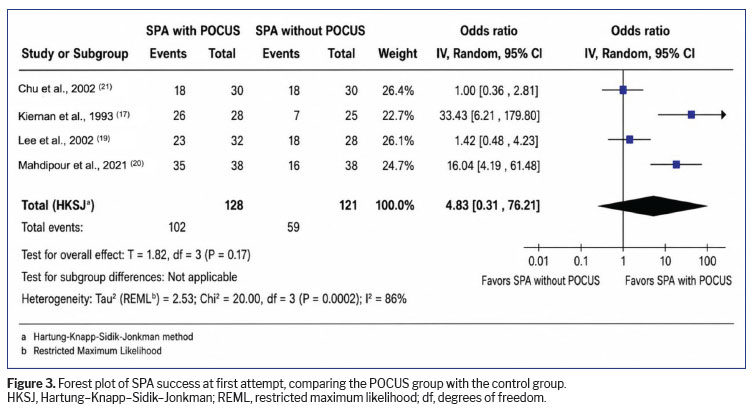
A secondary analysis revealed that POCUS guidance does not have a significant impact on first-attempt odds of success (OR = 4.83; 95% CI: 0.31–76.21;
p = 0.17; I
2 = 86%). That analysis also showed that there was high heterogeneity among the studies (I
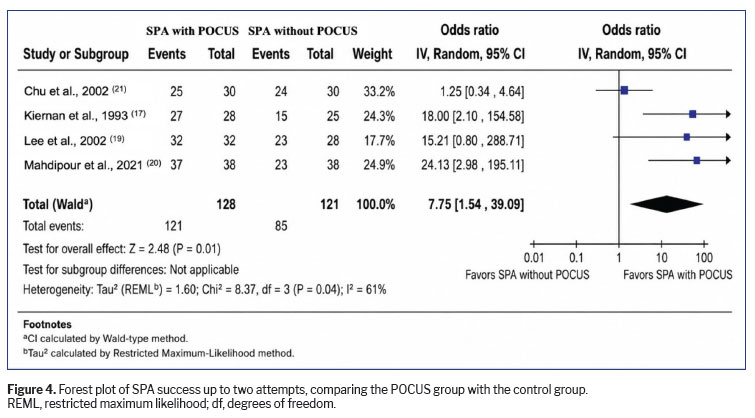
2 = 86%), suggesting substantial variation in the results (Figure 3), as further discussed below. There was a statistically significant difference in the odds of success within up to two attempts (OR = 7.75; 95% CI: 1.54–39.09;
p = 0.01; I
2 = 61%), further supporting the superiority of POCUS in this context (Figure 4). Leave-one-out sensitivity analysis was not performed due to the low I
2 indicated.
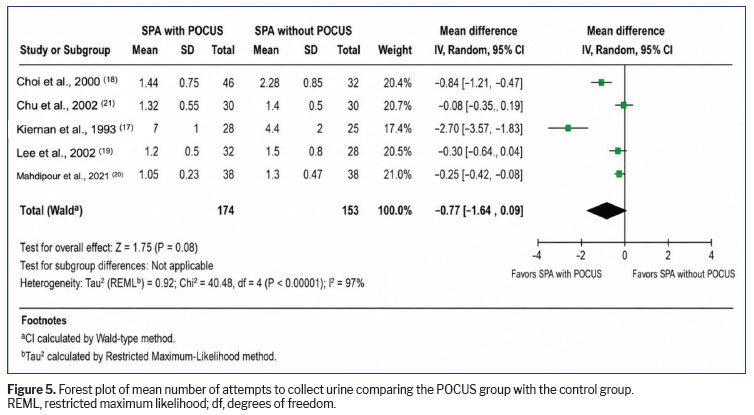
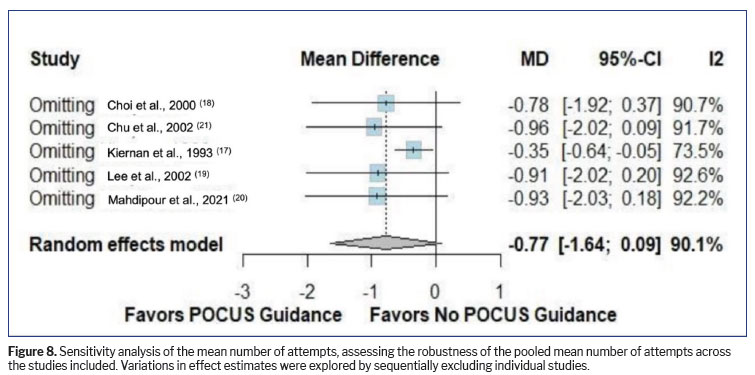
Mean number of attemptsPOCUS guidance did not have a significant impact on reducing the number of attempts, with a mean difference (MD) of −0.77 (95% CI: −1.64 to 0.09;
p = 0.08; I
2 = 97%). When the study conducted by Kiernan et al.
(18) was excluded, the leave-one-out sensitivity analysis showed a significant benefit of POCUS guidance (MD = −0.35; 95% CI: −2.02 to 0.09; I
2 = 73%).
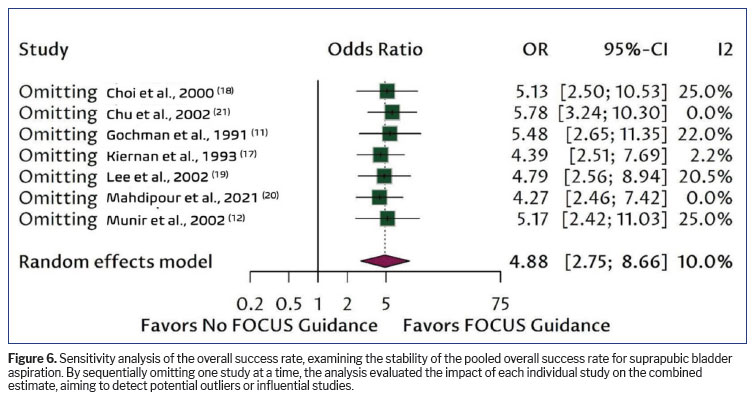
Sensitivity analysisA sensitivity analysis performed for the overall success rate showed that omitting the studies conducted by Chu et al.
(22) and Mahdipour et al.
(21) had a significant influence on heterogeneity, with ORs of 5.78 ( 95% CI: 3.24–10.30; I
2 = 0.0%) and 4.27 (95% CI: 2.46–7.42; I
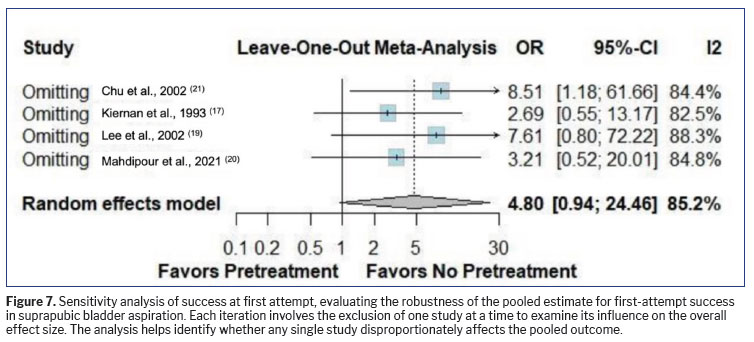
2 = 0.0%), respectively (Figure 6). A sensitivity analysis for first-attempt success did not find a specific study responsible for the heterogeneity (Figure 7). A sensitivity analysis for mean number of attempts identified the Kiernan et al. study
(18) as the primary source of heterogeneity, and exclusion of that study resulted in the achievement of statistical significance (MD = −0.35; 95% CI: −2.02 to 0.09; I
2 = 73%). Nonetheless, high heterogeneity persisted across studies (Figure 8).
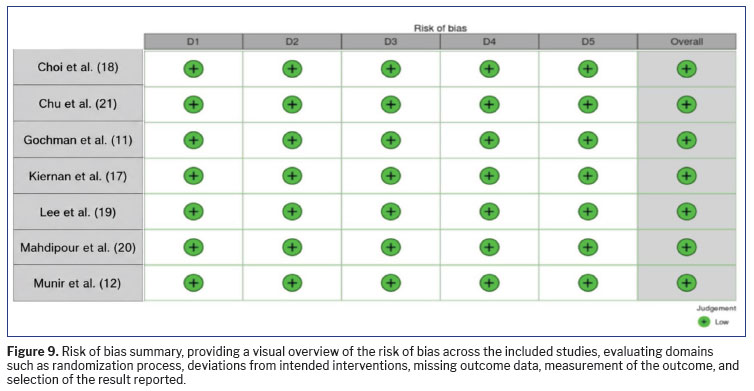
Risk of bias assessmentThe risk of bias across the five domains assessed for RCTs (selection, performance, detection, attrition, and reporting biases), evaluated by using the RoB 2 tool, was low and showed concordance between the two evaluators (E.F.M and L.B.S.C.), as illustrated in Figure 9.
DISCUSSIONIn this systematic review and meta-analysis, the pooled results of 468 patients demonstrated a significant improvement in the success rate of SPA due to POCUS guidance in pediatric patients. Overall, considering summarized raw data across studies, the success rate was 89.9% with POCUS and 63.6% without, representing a relative difference of approximately 41%. Success at first attempt occurred in 102 (79.7%) of the 128 cases in which POCUS was employed, compared with 59 (48.8%) of the 121 cases in which it was not. These findings indicate that using POCUS may improve the efficiency of SPA and reduce patient distress associated with the procedure by reducing the number of attempts needed. In addition to these benefits, POCUS offers practical advantages such as estimating bladder dimensions, confirming adequate bladder filling, and enabling real time visualization of the needle during the procedure, all of which contribute to a higher rate of procedural success.
Despite the benefits of POCUS in the overall success rate of SPA, some important considerations must be addressed. The first is the variability in operator experience, which may influence success rates and adoption of the method. Studies conducted in Brazil and Saudi Arabia, highlight a significant gap in medical education regarding POCUS training. A study conducted in Saudi Arabia showed that only 21.4% of final-year medical students had received formal POCUS training, revealing a deficiency in ultrasound proficiency among future physicians
(23). Similarly, research involving members of the Brazilian Society of Nephrology revealed that the majority (64%) of participants did not have the opportunity to develop ultrasound examination skills during their medical training
(24). Despite the well-documented benefits of POCUS, few medical programs offer structured training in this skill, emphasizing the urgent need to integrate ultrasound education into medical curricula to enhance the diagnostic and procedural capabilities of physicians
(25). In addition, there were notable methodological discrepancies among the trials included. The fact that only one study—that conducted by Mahdipour et al.
(21)—explicitly reported which health care professional performed each procedure limited our ability to assess the influence of operator expertise.
Availability is another important factor that may limit the widespread implementation of POCUS in SPA. While ultrasound devices are becoming more accessible, their availability remains inconsistent across different health care settings, particularly in low-resource settings
(13). Institutions with limited funding may lack portable ultrasound machines or may not have enough trained personnel to ensure real-time imaging during SPA procedures. In contrast, traditional (blind) SPA, although less precise, does not require additional equipment. Therefore, cost-effectiveness analyses comparing POCUS-guided SPA with alternative urine collection methods are warranted in order to guide policy decisions and optimize resource allocation.
This study has some limitations that should be considered. The majority of the studies included were published between 1991 and 2002, with the notable exception of that conducted by Mahdipour et al.
(21), which was published in 2021. Given the advances in technology and widespread use of POCUS, including integration of artificial intelligence, generalizability and contemporary applicability may be limited
(26). However, these technological innovations may have further improved SPA success rates, resulting in an underestimation of the impact of POCUS in our study. Bladder volume is also an important source of variability across studies, given that it represents an essential determinant of procedural success. Munir et al.
(12) demonstrated that the SPA success rate reaches nearly 90% when bladder volume exceeds 10 mL on ultrasound, highlighting the need for adequate bladder filling before the procedure. However, the remaining studies included in this meta-analysis did not apply a standardized bladder volume threshold, which may have contributed to the heterogeneity observed in diagnostic accuracy. Future methodologically rigorous RCTs should adopt consistent definitions and measurement protocols for bladder volume to more accurately evaluate its influence on the performance and success of ultrasound-guided SPA.
The accuracy of POCUS for SPA in infants depends on the technical capabilities of the ultrasound system. Older-generation machines with low resolution, analog interfaces, and minimal pediatric optimization likely increase reliance on operator skill and contribute to increasing the number of failed or uncertain punctures. In contrast, newer digital systems, introduced in the early 2000s, offer better image quality and usability, improving the effectiveness and ease of the procedure. In comparison, the device used by Gochman et al.
(11) in their study published in 1991 — the ScanMate II ultrasound system — was limited to a 60° scan angle, and a 10-cm depth range. In contrast, Mahdipour et al.
(21), in their 2021 study, used the Ultrasonix platform, which offered significantly higher resolution and advanced technologies like SonixDAQ, enabling over 10,000 frames per second and photoacoustic imaging. These technological developments appear to improve image clarity and facilitate real-time targeting, as well as potentially reducing operator dependency during procedures such as SPA. Enhanced bladder visualization, including in small infants, could potentially increase procedural accuracy. Such evolving capabilities may, in part, contribute to the heterogeneity observed across studies as ultrasound technology has advanced over time.
Heterogeneity was observed, particularly in first-attempt success rates (I
2 = 86%;
p > 0.001), potentially due to variations in operator expertise, ultrasound equipment, and reason for aspiration. For example, Gochman et al.
(11) and Kiernan et al.
(18) used the judgement of the medical team to determine the reason for aspiration, whereas Chu et al.
(22) used objective criteria: a urine sample testing positive for leukocyte esterase or nitrites; or the presence of leukocytes (> 5 mm
3) on microscopic examination. Although the mean number of attempts needed to achieve a successful SPA was lower among the POCUS-guided procedures than among the traditional procedures, statistical significance was not reached. This outcome appears to be influenced by substantial heterogeneity, primarily driven by a single outlier study — that conducted by Kiernan et al.
(18) — the results of which were markedly divergent from those of the other studies included in this review. Sensitivity analysis with the leave-one-out method suggests that exclusion of this study would have resulted in a statistically significant difference favoring POCUS, underscoring the considerable impact of the outlier on the overall findings.
Although the present meta-analysis provides valuable insights, it is important to acknowledge that most of the studies included are relatively dated and exhibit considerable methodological heterogeneity, which may limit the generalizability and current applicability of the results. Future research should prioritize the development of well-designed, contemporary RCTs that address these limitations. In particular, key methodological aspects such as operator expertise, ultrasound technology, and bladder volume at the time of assessment should be standardized or systematically evaluated to ensure that the findings are more reliable and reproducible across studies.
5. CONCLUSIONThis meta-analysis demonstrates the superiority of POCUS-guided SPA over traditional blind SPA in terms of the overall success rates of the procedure in pediatric patients. Compared with blind SPA, POCUS-guided SPA remains a more successful approach for obtaining a sterile urine sample in children. Despite the heterogeneity observed among the studies included in this review, the overall evidence supports the integration of POCUS into routine pediatric practice.
Conflicts of Interest: The authors have no conflicts of interest relevant to this article.
Funding/Support: No funding was secured for this study.
REFERENCES1. Mattoo TK, Shaikh N, Nelson CP. Contemporary Management of Urinary Tract Infection in Children. Pediatrics. 2021 Feb;147(2):e2020012138.
2. Greenhow TL, Hung YY, Herz AM, et al. The changing epidemiology of serious bacterial infections in young infants. Pediatr Infect Dis J. 2014 Jun;33(6):595–9.
3. Kuppermann N, Dayan PS, Levine DA, et al. A Clinical Prediction Rule to Identify Febrile Infants 60 Days and Younger at Low Risk for Serious Bacterial Infections. JAMA Pediatr. 2019 Apr 1;173(4):342–51.
4. Shaikh N, Morone NE, Bost JE, et al. Prevalence of urinary tract infection in childhood: a meta-analysis. Pediatr Infect Dis J. 2008 Apr;27(4):302–8.
5. Ladomenou F, Bitsori M, Galanakis E. Incidence and morbidity of urinary tract infection in a prospective cohort of children. Acta Paediatr. 2015 Jul;104(7):324–29.
6. Diviney J, Jaswon MS. Urine collection methods and dipstick testing in non-toilet-trained children. Pediatr Nephrol. 2021 Jul;36(7):1697–708.
7. ’t Hoen LA, Bogaert G, Radmayr C, et al. Update of the EAU/ESPU guidelines on urinary tract infections in children. J Pediatr Urol. 2021 Apr;17(2):200–7.
8. SUBCOMMITTEE ON URINARY TRACT INFECTION. Reaffirmation of AAP Clinical Practice Guideline: The Diagnosis and Management of the Initial Urinary Tract Infection in Febrile Infants and Young Children 2-24 Months of Age. Pediatrics. 2016 Dec;138(6):e20163026.
9. Baumann BM, McCans K, Stahmer SA, et al. Caregiver and health care provider satisfaction with volumetric bladder ultrasound. Acad Emerg Med. 2007 Oct;14(10):903–7.
10. Díaz-Gómez JL, Mayo PH, Koenig SJ. Point-of-Care Ultrasonography. N Engl J Med. 2021 Oct 21;385(17):1593–602.
11. Gochman RF, Karasic RB, Heller MB. Use of portable ultrasound to assist urine collection by suprapubic aspiration. Ann Emerg Med. 1991 Jun;20(6):631–5.
12. Munir V, Barnett P, South M. Does the use of volumetric bladder ultrasound improve the success rate of suprapubic aspiration of urine? Pediatr Emerg Care. 2002 Oct;18(5):346–9.
13. Hassanzadeh Rad A, Badeli H. Point-of-Care Ultrasonography: Is It Time Nephrologists Were Equipped With the 21th Century’s Stethoscope? Iran J Kidney Dis. 2017 Jul 1;11:259–62.
14. Sterne JAC, Savovic´ J, Page MJ, et al. RoB 2: a revised tool for assessing risk of bias in randomised trials. BMJ. 2019 Aug 28;366:l4898.
15. Review Manager (RevMan) [Computer program]. Copenhagen: The Cochrane Collaboration; 2020. Available from:
https://training.cochrane.org 16. RStudio: Integrated Development Environment for R [Posit Software]. Boston, MA: PBC; 2024. (Posit team). Available from:
http://www.posit.co/ 17. R Core Team. R: A Language and Environment for Statistical Computing [Computer program]. Vienna, Austria: R Foundation for Statistical Computing; 2024.
18. Kiernan SC, Pinckert TL, Keszler M. Ultrasound guidance of suprapubic bladder aspiration in neonates. J Pediatr. 1993 Nov;123(5):789–91.
19. Choi BM, Kim KB, Lee HH, et al. The Use of Ultrasonography in the Suprapubic Bladder Aspiration in Neonates. J Korean Soc Neonatol. 2001 Jan 1;7(2):139–44.
20. Lee JW, Park S, Cho SJ, et al. Suprapubic Bladder Aspiration Assisted by Ultrasound. J Korean Soc Pediatr Nephrol. 2002;68–74.
21. Mahdipour S, Saadat SNS, Badeli H, et al. Strengthening the success rate of suprapubic aspiration in infants by integrating point-of-care ultrasonography guidance: A parallel-randomized clinical trial. PloS One. 2021;16(7):e0254703.
21. Chu RWP, Wong YC, Luk SH, et al. Comparing suprapubic urine aspiration under real-time ultrasound guidance with conventional blind aspiration. Acta Paediatr. 2002;91(5):512–6.
23. Nassar SM, Almubrik SA, Alyahya L, et al. Perception, Knowledge, Indications, and Future Prospects of Point-of-Care Ultrasound Among Medical Students in Saudi Arabia. Cureus. 2024 Apr;16(4):e57704.
24. Bastos MG, Vieira AL, Nascimento MM do, et al. Point-of-care ultrasonography in nephrology: a cross-sectional national survey among Brazilian nephrologists. Braz J Nephrol J Bras Nefrol. 2020 Oct 5;00(00):68–73.
25. Gold D, Levine M, Hsu D, et al. Design of a point-of-care ultrasound curriculum for pediatric emergency medicine fellows: A Delphi study. AEM Educ Train. 2021 Aug;5(4):e10700.
26. Venkatayogi N, Gupta M, Gupta A, et al. From Seeing to Knowing with Artificial Intelligence: A Scoping Review of Point-of-Care Ultrasound in Low-Resource Settings. Appl Sci. 2023 Jul 21;13:8427.
1. Department of Medicine, Bahiana School of Medicine and Public Health, Salvador, BA, Brazil
2. Department of Medical Sciences, Federal University of Bahia, Salvador, BA, Brazil
3. Departments of Pediatrics, Emergency Medicine, and Radiology, University of Pittsburgh School of Medicine, Pittsburgh, PA, USA
4. Zarns School of Medicine, Salvador, BA, Brazil
a.
https://orcid.org/0000-0001-5113-5309b.
https://orcid.org/0009-0003-6426-6393c.
https://orcid.org/0009-0003-1839-1636d.
https://orcid.org/0009-0001-3818-5560e.
https://orcid.org/0009-0008-9233-8549f.
https://orcid.org/0009-0005-4497-3343g.
https://orcid.org/0009-0008-4297-9487h.
https://orcid.org/0000-0003-3090-664Xi.
https://orcid.org/0009-0008-0689-3758Correspondence:Bianca S. Romeo
Department of Medicine, Bahiana School of Medicine and Public Health.
Avenida Dom João VI, 275, Salvador, BA, Brazil, 40290-000.
Email:
biancaromeo21.2@bahiana.edu.brEditor in charge: Dr. Valdair Francisco Muglia.
Data availability: Not applicable
Received in
October 8 2025.
Reviewed in
November 11 2026.
Accepted em
March 23 2026.
Publish in
August 28 2026.

 |
|







 PDF English
 Print
Print
 Send this article by email
 How to cite this article
 Submit a comment
 Mendeley
 Pocket
 Share on Facebook
 Share on Twitter